
Documents Required for DPIIT Recognition: A Founder’s Checklist
09 Oct 2026 · SNB Admin
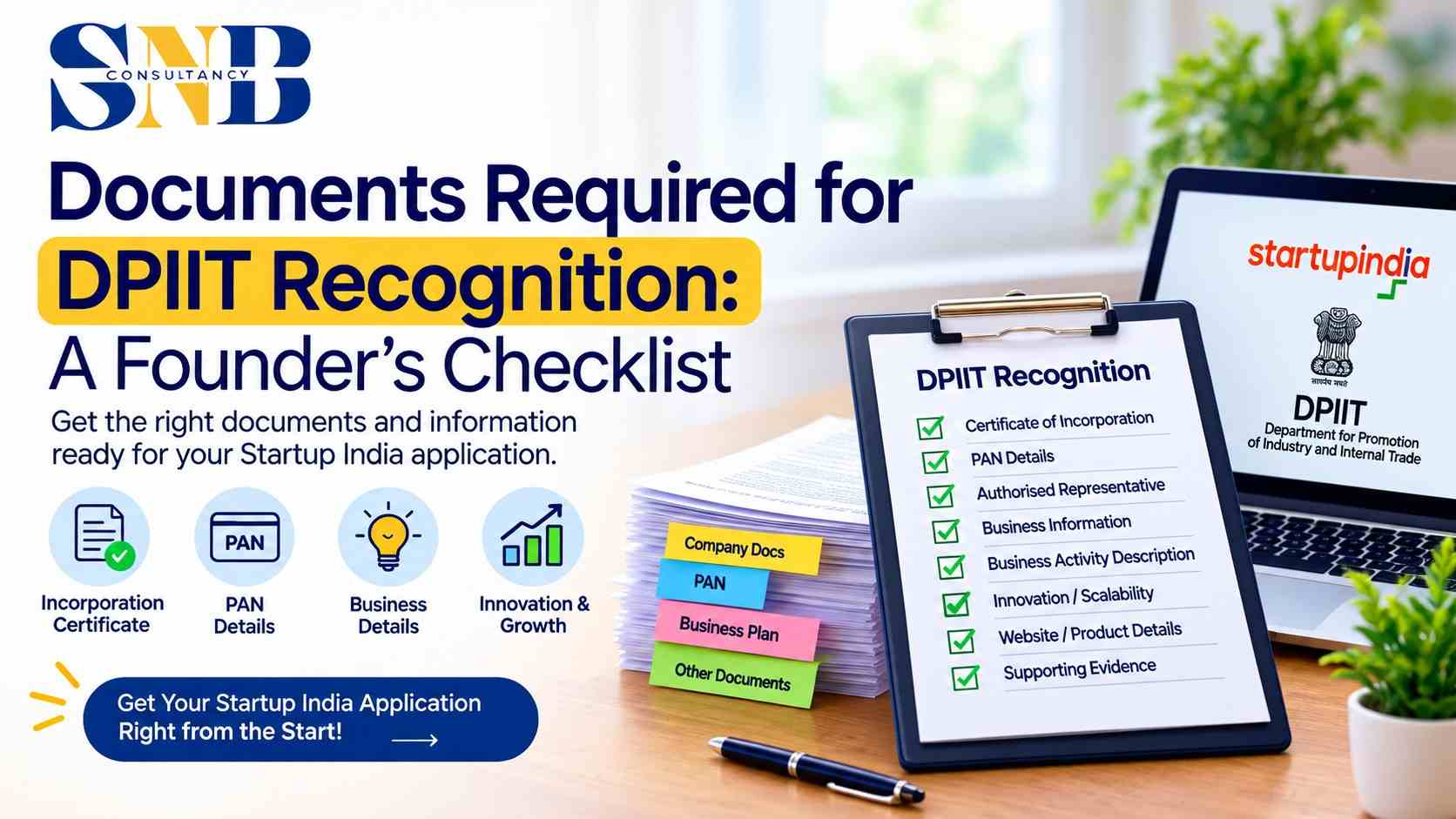
A startup founder may have a promising business idea, a working product, and a registered company, but preparing a DPIIT recognition application can still raise questions. Which documents are essential? Is a company PAN compulsory? Do you need a website or pitch deck? And how can you explain your startup’s innovation clearly?
Understanding the documents required for DPIIT recognition before starting the application can help you prepare accurate information, organise relevant evidence, and reduce avoidable mistakes.
DPIIT recognition is available to eligible startups under the Startup India initiative. The application process and supporting documents may depend on the entity’s legal structure, business activities, and specific circumstances. The official Startup India portal identifies the incorporation or registration certificate and an explanation of the startup’s innovation, product or service development, improvement, or scalability as central requirements.
This guide explains what founders should prepare, which supporting materials may be useful, and how to approach the application process.
What Is DPIIT Recognition?
DPIIT recognition is an official recognition granted by the Department for Promotion of Industry and Internal Trade (DPIIT) to eligible startups under the Startup India initiative.
It can help qualifying startups access applicable benefits and support, including certain intellectual property facilitation measures and easier compliance provisions, subject to the relevant conditions.
DPIIT recognition is different from business incorporation. Incorporation legally establishes an entity, such as a private limited company or limited liability partnership (LLP). DPIIT recognition is a separate process that assesses whether an existing entity meets the applicable startup definition and eligibility conditions.
Registering a company does not automatically make it a DPIIT-recognised startup. Founders must apply through the designated government portal and provide the required information and supporting documents.
Documents Required for DPIIT Recognition: A Practical Checklist
The first step is to distinguish between the core document required for recognition and additional information or evidence that may be requested by the application.
1. Certificate of Incorporation or Registration
The incorporation or registration certificate is the key document identified in the official Startup India FAQ. It establishes that the applicant is a legally registered entity.
Keep the relevant document ready:
-
Private limited company: Certificate of Incorporation issued by the Ministry of Corporate Affairs.
-
Limited liability partnership: Certificate of Incorporation issued for the LLP.
-
Registered partnership firm: Registration certificate issued by the Registrar of Firms.
-
Cooperative society: Applicable registration documentation, as required by the current portal instructions.
The exact document depends on the entity type. Ensure that the uploaded certificate is clear and that the legal name and registration details match the application.
2. PAN Details
Keep the entity’s Permanent Account Number (PAN) details available, along with any related information requested by the portal.
A company’s PAN is different from a founder’s personal PAN. Do not confuse the two when entering information.
The official recognition page and application instructions should be checked for the current PAN-related requirements applicable to your entity. Even where a PAN document is not separately required, having the correct entity details ready is a sensible preparation step.
3. Authorised Representative’s Details
The application may require information about the person authorised to submit or manage it.
Prepare the relevant details, such as the representative’s name, contact number, email address, and authorisation information where applicable.
Use contact details that the authorised representative can access. The current application may require verification or additional authorisation documentation. Follow the instructions displayed on the official portal rather than assuming that a particular format is universally compulsory.
4. Business and Registration Information
Before starting the DPIIT recognition application, collect the basic details of the entity, including:
-
Legal name as recorded on the incorporation or registration certificate.
-
Date of incorporation or registration.
-
Registration number, CIN or LLPIN, where applicable.
-
Registered office address.
-
Type of legal entity.
-
Applicable industry, sector and business activity details.
These details help you complete the application consistently. If the registered address, legal name or registration information has changed, check whether the relevant records need updating before submitting the application.
5. Business Activity Description
One of the most important parts of the application is explaining what the startup actually does.
Prepare a clear description covering the product or service, the problem it addresses, the intended customers, and how the business operates.
The official Startup India FAQ specifically asks applicants to explain how their startup works towards innovation, development or improvement of products, processes or services, or scalability in employment generation or wealth creation.
Avoid relying on broad statements such as “we provide innovative solutions.” Explain the actual solution and why it is useful.
6. Innovation, Improvement or Scalability Information
Founders should prepare a practical explanation of how their business meets the relevant startup criteria.
Depending on the business, this may involve explaining:
-
What is new or different about the product or service.
-
How the startup improves an existing product, process or service.
-
What specific problem the business solves.
-
How the business model could scale.
-
How the business has the potential to generate employment or create wealth.
Do not claim that a business is innovative merely because it operates online or uses technology. Explain the meaningful difference in the offering, process or business model.
7. Website, Product or Service Information
A website can help reviewers understand the business, but founders should not assume that every supporting item is universally mandatory.
Depending on the application requirements and the startup’s stage, useful material may include:
-
A website or product page.
-
A product demonstration video.
-
A pitch deck.
-
Screenshots of a working product.
-
A prototype or proof-of-concept demonstration.
Check the current application instructions to determine which materials must be submitted. A startup without a fully launched product should prepare the most relevant evidence of its current development stage.
8. Supporting Evidence of Business Activities
Additional evidence may help explain the startup’s operations and business model where requested or relevant.
Examples include product specifications, prototype details, customer information, intellectual property documentation, or other material that supports claims made in the application.
These are practical examples, not a universal list of compulsory attachments. The official portal’s requirements for the particular application take priority.
9. Additional Documents for Specific Circumstances
Some applications may involve circumstances requiring extra documentation. For example, a change in the entity’s name, conversion between legal structures, or a merger-related situation may require relevant supporting records.
Review the current instructions carefully if your business has undergone any such change. Do not submit unrelated documents simply to make the application appear more substantial.
Founder’s Pre-Application Checklist
Before beginning the DPIIT application, use this checklist to organise your information.
This preparation can make the application easier to complete and help you identify missing information before submission.
How to Prepare a Strong Business Description
A business description should explain the startup in terms that a reviewer can understand without guessing what the business does.
Consider this example.
Weak description: “We are an innovative technology company providing the best solutions to customers.”
This statement does not explain the actual product, target market or value offered.
Clearer description: “We develop inventory management software for small retailers. The platform helps shop owners track stock, identify low-inventory items and manage orders through a single dashboard.”
The second example explains the product, intended customers and practical benefit. If the business has a genuinely distinctive feature, the founder can describe it separately and explain how it differs from existing solutions.
Good wording does not guarantee DPIIT recognition. The description should accurately represent the business and support the applicable eligibility criteria.
Common Document and Application Preparation Mistakes
Founders can avoid several common mistakes by reviewing their application before submission.
Inconsistent company details: A mismatch between the legal name, registration certificate and application can create confusion. Verify official records before entering details.
Incomplete information: Missing business information or unclear responses can make it harder to understand the startup. Review each applicable field carefully.
Unsupported innovation claims: Avoid describing a product as unique or revolutionary without explaining the underlying improvement or innovation.
Outdated supporting material: If your product has changed significantly, ensure that the submitted screenshots, pitch deck or product description reflect its current state.
Assuming incorporation guarantees recognition: Business incorporation and DPIIT recognition are separate processes. The startup must satisfy the relevant recognition criteria.
Treating every supporting item as compulsory: A website, patent, pitch deck or customer list should not automatically be treated as mandatory for every applicant. Follow the actual requirements of the current application.
How to Apply for DPIIT Recognition
The official Startup India portal directs applicants to the National Single Window System (NSWS) for DPIIT startup recognition.
The general process is as follows:
-
Visit the official Startup India recognition page.
-
Follow the link to the National Single Window System and create an account if necessary.
-
On the NSWS dashboard, select Add Approvals, then Central Approvals.
-
Find and add the Registration as a Startup application.
-
Complete the applicable information, upload the requested documents and submit the application.
-
Monitor the application and respond to any request for clarification or additional information.
The current portal instructions should be treated as authoritative for the application fields, document formats and any additional requirements. Do not rely on old checklists or assume a fixed approval timeline.
The government states that it has not appointed any agency, representative or franchise to issue DPIIT recognition certificates, and that it does not charge a fee for DPIIT recognition. Founders should apply using their own details and contact information.
Does DPIIT Recognition Require a Separate Section 80-IAC Application?
Yes. DPIIT recognition and eligibility for the Section 80-IAC income-tax benefit are separate matters.
After obtaining DPIIT recognition, an eligible startup may apply separately for the Section 80-IAC tax exemption. The official Startup India page specifies that only recognised startups meeting the applicable conditions, including the relevant private limited company or LLP requirements, may apply. Approval is not automatic merely because a startup has received DPIIT recognition.
Founders interested in the tax benefit should review the separate eligibility conditions and application requirements before relying on any projected tax savings.
When Should a Founder Consult a DPIIT Registration Consultant?
Preparing an application may be more challenging when the founder is uncertain about eligibility, the appropriate supporting evidence or how to explain the business model.
Professional assistance may be useful if:
-
You are unsure whether your entity meets the current criteria.
-
Your business model is complex or difficult to explain.
-
You need help organising supporting documents.
-
You are uncertain about the distinction between DPIIT recognition and Section 80-IAC eligibility.
-
Your entity has undergone a name change or another structural change.
SNB Consultancy supports entrepreneurs with startup registration and related business compliance services. Founders looking for a DPIIT registration consultant in Ahmedabad can seek assistance with understanding the process, preparing application information and organising relevant documentation.
Professional support can help with preparation, but recognition is subject to the applicable government requirements and decision-making process. No consultant can guarantee approval.
Frequently Asked Questions
1. What documents are required for DPIIT recognition?
The official Startup India FAQ identifies the incorporation or registration certificate and an explanation of the startup’s innovation, improvement or scalability as key requirements. Other information and supporting documents depend on the current application instructions and the entity’s circumstances.
2. Is a Certificate of Incorporation required for DPIIT recognition?
An incorporation or registration certificate is a core requirement. The applicable document depends on the legal structure of the entity.
3. Is a company PAN required for the application?
Keep the entity’s PAN details ready and follow the current portal requirements. Do not confuse the entity’s PAN with a founder’s personal PAN.
4. Is a website compulsory for DPIIT recognition?
Do not assume that a website is universally compulsory. Check the current application instructions and prepare relevant evidence of your business activities.
5. Is a pitch deck required for every startup?
Not necessarily. A pitch deck may be useful supporting material, particularly when explaining a product or business model, but the documents required depend on the application instructions and circumstances.
6. Can an LLP apply for DPIIT recognition?
Yes. LLPs are among the eligible entity types listed on the official Startup India recognition page, subject to the applicable criteria.
7. Does DPIIT recognition require proof of innovation?
Applicants must explain how their startup works towards innovation, development or improvement, or meets the relevant scalability criteria. Supporting evidence should be prepared where applicable or requested.
8. Can a startup apply if its product is still under development?
A product does not necessarily need to be fully launched for a startup to explain its activities. Prepare relevant evidence of the development stage and check the current portal requirements. Eligibility and recognition are assessed under the applicable criteria.
9. What should I do if additional information is requested?
Review the request carefully, identify the missing information and provide an accurate response with relevant supporting documents through the designated process. Keep copies of submitted material for your records.
10. Does DPIIT recognition automatically provide the Section 80-IAC tax benefit?
No. Section 80-IAC involves a separate application and additional eligibility and approval requirements. DPIIT recognition alone does not grant the tax benefit.
Conclusion
Preparing the documents required for DPIIT recognition is about more than collecting certificates. Founders should verify their eligibility, ensure their entity details are accurate, and explain their business activities and innovation clearly.
Before applying, review the latest official Startup India and NSWS instructions, because requirements may change and additional documents may be needed in specific circumstances.
If you need help understanding startup registration, organising your application information or preparing for DPIIT recognition, SNB Consultancy can help you navigate the process.
Ready to get started?
Tell us where your business is today. A named advisor will map the next steps — and the fee — before you commit to anything.