
What Is DPIIT Recognition and Why Is It Important for Startups?
22 Sep 2026 · SNB Admin
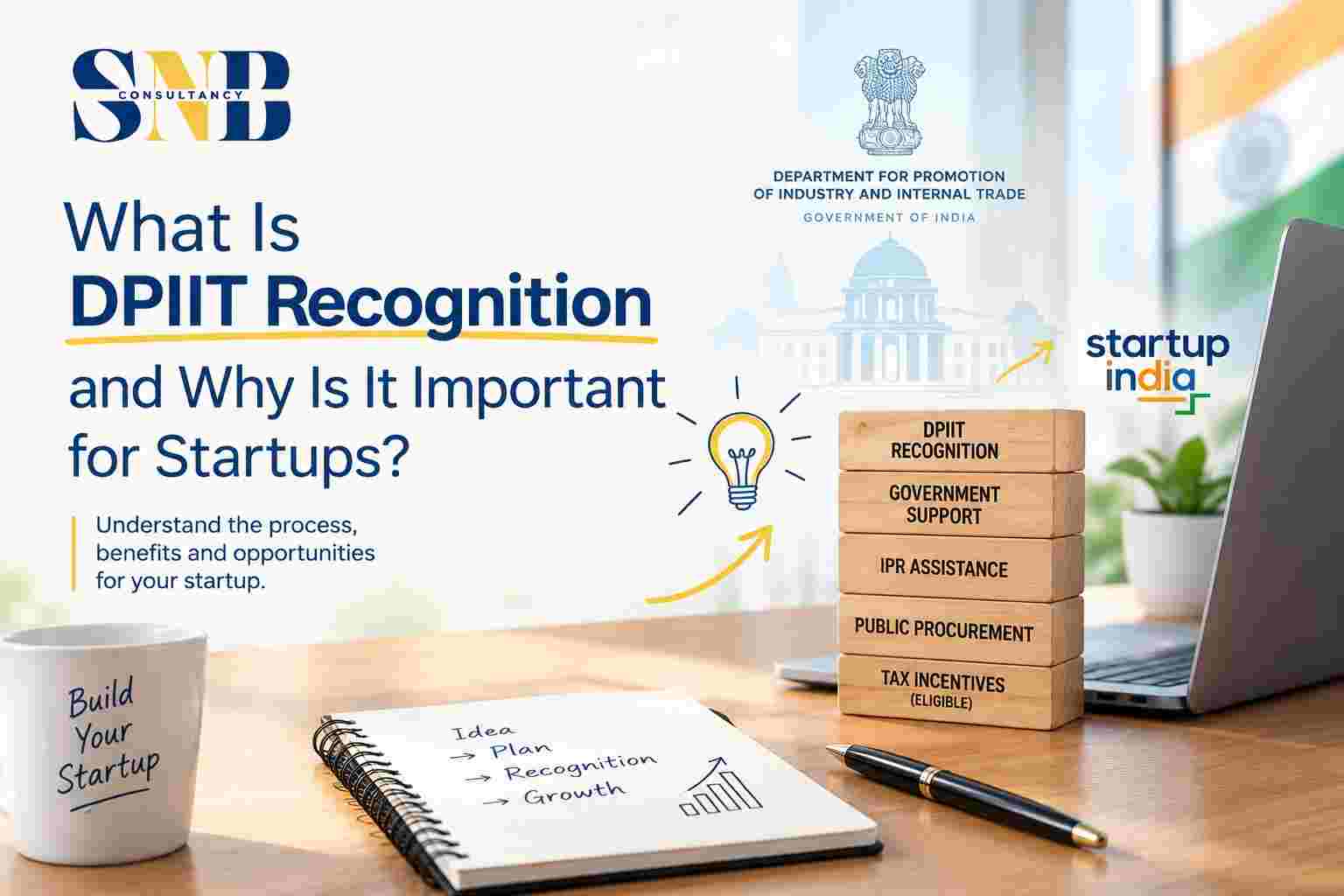
Have you started a business and heard about DPIIT recognition, but are not sure what it actually means or whether your startup needs it?
DPIIT recognition is a government recognition available to eligible startups under the Startup India initiative. It can open the door to various benefits and support mechanisms, but recognition itself does not automatically give a startup every tax exemption, scheme or government benefit.
For founders, the important part is understanding the difference between registering a business, obtaining DPIIT startup recognition and applying separately for benefits that have their own eligibility conditions.
If you are considering Startup India registration, this guide explains what DPIIT recognition means, who can apply, the benefits that may be available and how the recognition process generally works.
What Is DPIIT Recognition?
DPIIT stands for the Department for Promotion of Industry and Internal Trade, under the Ministry of Commerce and Industry, Government of India.
DPIIT Startup Recognition is a formal recognition given to eligible entities that meet the applicable definition and conditions for a startup. The recognition is part of the Startup India initiative and is intended to help eligible startups access various government support measures.
In simple terms, if your business meets the applicable startup criteria, you can apply for recognition through the prescribed online process. Once recognised, your business becomes a DPIIT recognised startup and may become eligible to apply for certain benefits and schemes.
The important word here is eligible. DPIIT recognition does not mean that every benefit listed under Startup India automatically becomes available to your business. Individual incentives can have separate conditions, applications and approval requirements.
Is DPIIT Registration the Same as Startup India Registration?
These terms are often used interchangeably, which can create confusion.
Startup India is the broader government initiative supporting the startup ecosystem in India. DPIIT recognition is the formal startup recognition process under that initiative.
You may therefore hear people use phrases such as "Startup India registration" or "DPIIT registration" while referring to the process of getting startup recognition. However, technically, the relevant government recognition is DPIIT Startup Recognition.
The current application process is available through the National Single Window System (NSWS). Eligible entities can create an account, add the "Registration as a Startup" approval and submit the required information.
So, when searching for a DPIIT registration consultant, it is useful to understand that the objective is not simply to obtain a generic business registration. The objective is to determine whether your entity qualifies for DPIIT startup recognition and then complete the applicable recognition process correctly.
If you are still deciding what type of business structure to establish, you may also find our guide on [Internal Link: Startup Registration] useful.
Who Can Apply for DPIIT Startup Recognition?
DPIIT eligibility depends on the current government notification and the nature of the entity. The rules can also change, so founders should verify the latest criteria before applying.
As of the current Startup India requirements, eligible entities can include a Private Limited Company, registered Partnership Firm, Limited Liability Partnership or Cooperative Society.
For a regular startup, the current framework provides that the entity should generally be within 10 years from its incorporation or registration and should not have exceeded the applicable turnover limit. The current Startup India portal states a turnover threshold of ₹200 crore, while a separate framework applies to recognised DeepTech startups, for which the period can extend to 20 years and the turnover limit can be ₹300 crore.
The business should also be working towards innovation or improvement of products, services or processes, or have a scalable business model with significant potential for employment generation or wealth creation. An entity formed by splitting up or reconstructing an existing business does not qualify as a startup under the applicable criteria.
This is why founders should not assume that every newly incorporated company automatically qualifies. Incorporation and startup recognition are separate matters.
What Are the Benefits of DPIIT Recognition?
One of the main reasons founders explore DPIIT recognition is the range of benefits and support mechanisms associated with recognised startups.
The exact benefit available to a startup depends on the relevant scheme and its conditions. Recognition should therefore be viewed as an eligibility gateway rather than a guarantee of every benefit.
Government Recognition
A DPIIT recognition certificate provides formal recognition of the entity as a recognised startup under the Startup India framework.
This can be useful when the startup applies for schemes, programmes or other facilities where DPIIT recognition is a qualifying requirement.
Intellectual Property Support
Recognised startups can access certain intellectual property related support under Startup India initiatives. This includes support mechanisms relating to patent applications and IPR protection, subject to the applicable rules and procedures.
For startups developing technology, products, brands or other intellectual property, understanding these facilities can be particularly useful.
Founders should still separately assess whether a patent, trademark or another form of IP protection is appropriate for their business.
You can also explore [Internal Link: Trademark Registration] if brand protection is relevant to your startup.
Public Procurement Opportunities
DPIIT recognition can also be relevant when a startup wants to participate in government procurement.
Startup India lists easier public procurement norms among the benefits available to recognised startups. Certain conditions and procurement rules continue to apply, so recognition does not mean that every government tender is automatically available to the startup.
For a startup selling products or services to government departments, this can be an area worth exploring carefully.
Tax Related Opportunities
Tax benefits are another area that attracts considerable interest from startup founders. However, this is where misunderstandings are common.
DPIIT recognition can make an eligible startup capable of applying for certain tax benefits, but the startup must satisfy the separate requirements applicable to the particular tax provision.
Section 80-IAC is a good example.
DPIIT Recognition and Section 80-IAC
DPIIT recognition and Section 80-IAC are related, but they are not the same thing.
A startup must first have DPIIT recognition to apply for the Section 80-IAC tax exemption. However, DPIIT recognition by itself does not automatically provide the 80-IAC tax deduction.
Section 80-IAC has its own eligibility requirements and evaluation process. The Startup India portal explains that an eligible recognised startup may apply for the tax exemption after obtaining DPIIT recognition.
Under the current Startup India information, eligible startups can receive a 100% deduction for three consecutive financial years within the first ten years of incorporation, subject to the applicable requirements and approval.
Therefore, the practical distinction is:
Business Registration → DPIIT Recognition → Separate application for applicable benefits
A founder should not treat a DPIIT startup recognition certificate as an automatic approval for every tax benefit.
If you are researching this specifically, you can read our [Internal Link: 80-IAC Tax Benefit] guide for a more detailed explanation.
What Is a DPIIT Recognition Certificate?
After successful recognition, the startup receives a DPIIT recognition certificate.
The certificate serves as evidence that the entity has been recognised under the Startup India framework. The Startup India portal also provides a facility to verify or download recognition certificates, and the certificate can be accessed through DigiLocker.
Founders should keep the certificate and related business records properly maintained. The information submitted during recognition should also remain consistent with the company's official records.
This becomes particularly relevant when the startup later applies for schemes or benefits where DPIIT recognition is required.
How Does the DPIIT Recognition Process Work?
The current recognition process is online. DPIIT recognition for eligible entities is available through the National Single Window System.
At a practical level, the process involves first checking whether the entity satisfies the applicable startup eligibility requirements. The founder then prepares the relevant business information and supporting documents required by the current application process.
The application is submitted through the prescribed online platform. The information provided may be verified, including the entity's incorporation details, supporting documents and startup-related information. DPIIT recognition is then granted if the application satisfies the applicable requirements.
The Startup India recognition form also indicates that information submitted by the startup is based on self-certification, making accuracy and consistency particularly important.
Because government procedures can be updated, founders should check the current Startup India and NSWS requirements before submitting an application.
Documents and Information Required
There is no single fixed document list that should be assumed to apply to every startup in every situation.
The information required can depend on the entity type, application details and current government requirements. Generally, the application involves details relating to the legal entity, incorporation or registration, PAN and the nature of the startup's business.
The startup may also need to provide information explaining its product, service, innovation, improvement or scalable business model and how it fits within the applicable startup criteria.
The safest approach is to review the current application requirements before preparing the submission rather than relying on an old checklist found online.
Common Mistakes Startups Should Avoid
One common mistake is applying without first checking eligibility. A business may be newly incorporated but still not satisfy all the conditions for DPIIT startup recognition.
Another issue is inconsistent information. The details submitted in the recognition application should be carefully checked against the startup's incorporation and business records.
Founders should also avoid assuming that DPIIT recognition automatically provides tax exemption. As discussed above, benefits such as Section 80-IAC have separate conditions and processes.
It is also risky to rely on outdated articles or old eligibility thresholds. The Startup India portal currently notes that the turnover threshold was revised from ₹100 crore to ₹200 crore through the February 2026 notification, which is a good example of why current government information should be checked before applying.
Finally, keep copies of relevant certificates, application information and business documents properly organised for future reference.
Should You Use a DPIIT Registration Consultant?
Not every startup needs professional assistance. If the founders understand the eligibility criteria, have their records in order and are comfortable completing the online application, they may be able to handle the process themselves.
A DPIIT registration consultant can nevertheless be useful when founders are unsure about eligibility, have questions about entity structure, need help organising application information or want someone to review the documentation before submission.
Professional assistance can help reduce avoidable errors, but no consultant can guarantee that DPIIT will approve an application. The final recognition depends on the applicable government requirements and evaluation.
Also, founders should be cautious about anyone claiming to be officially appointed by DPIIT. The Startup India portal specifically states that DPIIT has not appointed any agency, representative or franchise for its Certificate of Recognition or Certificate of Eligibility, and that the Ministry does not charge a fee for these certificates.
SNB Consultancy
SNB Consultancy assists entrepreneurs with understanding the DPIIT recognition process and related startup registration and compliance requirements.
For founders who are unsure about their DPIIT eligibility, application information or supporting records, professional guidance can make it easier to understand what needs to be prepared before applying.
If you are based in Gujarat and searching for a DPIIT registration consultant in Ahmedabad, the same principle applies: first understand your eligibility and requirements, then decide whether you need professional assistance with the application.
The goal should be to submit accurate information based on the startup's actual business and official records rather than treating recognition as a guaranteed outcome.
For related business setup requirements, you can also explore [Internal Link: Company Registration], [Internal Link: LLP Registration] or [Internal Link: Business Registration].
Frequently Asked Questions
What is DPIIT recognition?
DPIIT recognition is government recognition provided to eligible startups under the Startup India initiative. It allows recognised startups to become eligible to apply for certain government benefits, schemes and support mechanisms, subject to the conditions applicable to each benefit.
Who is eligible for DPIIT recognition?
Eligibility depends on the current DPIIT criteria. Eligible entities can include Private Limited Companies, registered Partnership Firms, LLPs and Cooperative Societies. The startup must also satisfy applicable conditions relating to age, turnover, innovation or improvement, scalability and other requirements.
Is DPIIT recognition mandatory for startups?
No. DPIIT recognition is not the same as incorporating or registering a business. A business can be legally incorporated without being DPIIT recognised. However, recognition may be relevant if the startup wants to access benefits or schemes for which DPIIT recognition is a requirement.
What are the benefits of DPIIT recognition?
Recognised startups may be able to access benefits relating to intellectual property support, public procurement, regulatory support, tax related opportunities and other Startup India initiatives. Each benefit has its own rules and eligibility requirements, so recognition does not automatically provide every benefit.
Is DPIIT recognition the same as Startup India registration?
They are closely connected but should not be treated as identical terms. Startup India is the broader government initiative, while DPIIT recognition is the formal recognition of an eligible startup under the initiative.
Does DPIIT recognition provide tax exemption?
Not automatically. DPIIT recognition can be a prerequisite for applying for certain tax benefits, but those benefits have separate eligibility requirements and approval processes. Section 80-IAC is one example.
Is DPIIT recognition the same as 80-IAC approval?
No. DPIIT recognition and Section 80-IAC approval are separate. A startup must first be recognised by DPIIT before applying for the 80-IAC tax exemption, but recognition alone does not mean the startup has received 80-IAC approval.
How can a startup apply for DPIIT recognition?
Eligible startups can apply online through the National Single Window System by creating an account, adding the "Registration as a Startup" application and submitting the required information and supporting documents.
Can a DPIIT registration consultant help with the application?
Yes. A consultant can assist with understanding eligibility, preparing application information, reviewing documents and navigating the application process. However, professional assistance does not guarantee government recognition.
Conclusion
DPIIT recognition can be an important step for eligible startups that want to explore the benefits and support available through the Startup India ecosystem.
The key is to understand what recognition actually provides. It is not a replacement for business registration, and it does not automatically grant every government scheme or tax benefit. Individual benefits can have their own eligibility requirements, applications and approvals.
Before applying, founders should check the latest DPIIT requirements and make sure the information submitted accurately reflects their business.
If you need help understanding the DPIIT recognition process, startup registration or related compliance requirements, SNB Consultancy can assist you in assessing the requirements and preparing for the application process.
Ready to get started?
Tell us where your business is today. A named advisor will map the next steps — and the fee — before you commit to anything.